
French political paralysis, the cost is as high as 7.50 billion! Euro downside alarm sounded
France's Fifth Republic has its fourth prime minister since early elections in June 2024 led to a hung parliament, whose economic uncertainty has been reflected in rising yields, signalling a price to pay for political turmoil.
The price of instability
French taxpayers are expected to incur additional interest payments of €60 to €7.50 billion over the life of the outstanding debt as a result of the political turmoil that begins in June 2024. This "instability surcharge" is so far close to the annual budget for France's housing allowance (APL) for low- and middle-income groups - the cornerstone of France's social security system. The cost increases for each day of continued instability.
While Sebastian Le Corny's second term as prime minister has stabilised markets, yields on 10-year French government bonds, a barometer of fiscal risk, remain well above their long-term average. Short-term extreme political risks may subside, but long-term fiscal concerns remain. Far from calming market jitters, S & P's rating downgrade on October 17 will exacerbate this sentiment.
market perspective
From a bond investor's point of view, credit risk in France is becoming increasingly problematic. At the end of Quarter 1 2025, France's debt-to-GDP ratio stood at 114.1 per cent, the third highest in the eurozone, behind Greece (152.5 per cent) and Italy (137.9 per cent). In the European bond market, the key measure of fiscal risk is the spread between a country's 10-year bond yield and that of Germany over the same period. German government bonds are the safe benchmark asset in the eurozone - against which all other assets are referenced. All else being equal, the widening spread between the French 10-year bond (OAT) and German 10-year bond (Bund) yields means that the French economy has deteriorated. In France, this spread is mainly driven by political risk.
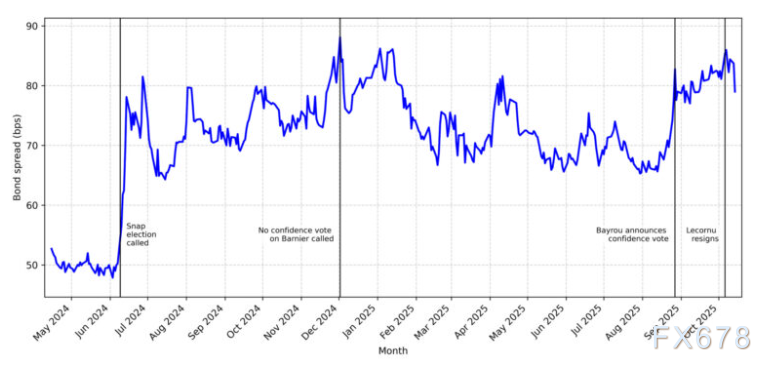
(Graph 1: The spread between 10-year French government bonds and German government bonds)
Between July 27, 2022, when the ECB began its post-epidemic rate hike cycle, and June 9, 2024, when France suddenly holds parliamentary elections, the average spread between 10-year French bonds and German bunds is 53 basis points, in line with the post-crisis eurozone average. Between election day and October 16, 2025, the average spread rises to 74 basis points - the extra yield that bond investors demand to compensate for the risk of political instability.
The composition of investors in the French sovereign bond market amplifies the sensitivity of the OAT-Bund spread to French domestic politics (Figure 1). According to UniCredit research, 55 per cent of French bond investors are foreign banks, offshore non-bank Financial Institutions Groups and foreign central banks - a much higher proportion than Italy or Spain, which have historically been equally prone to fiscal deficits.
Some 25 per cent of French government bonds are held by foreign non-bank Financial Institution Groups - investors most sensitive to negative news and rising uncertainty. Such groups amplify the resilience of 10-year yields to domestic political dysfunction, and it is through the transmission mechanism formed by these foreign non-bank institutions that political gridlock in France eventually translates into higher state financing costs.
long-term vision
The change in the spread between 10-year French and German Bund yields reflects a shift in market perceptions of fiscal risk in France relative to Germany, while the shift in the French yield curve itself reveals investors' expectations of the balance of short- and long-term risks. The key measures of short-term economic and fiscal expectations relative to long-term expectations are the two- and 10-year yield curves. A steepening of the yield curve may reflect expectations of a stronger economy, higher interest rates and higher inflation, and may also imply a rise in long-term risk premia.
Since the June 2024 snap election, long-term government bond yields have risen much faster than short-term options. While this coincides with the start of the ECB's rate-cutting cycle, a policy that drives down short-term yields, the continued rise in long-term yields (Figure 2) suggests that structural factors, particularly political and fiscal uncertainty, have outweighed cyclical factors such as changes in policy rates.The sharp steepening of the yield curve reflects that investors are demanding higher premiums to compensate for the risks posed by mounting budget deficits, reform gridlock and an expected increase in sovereign bond issuance.
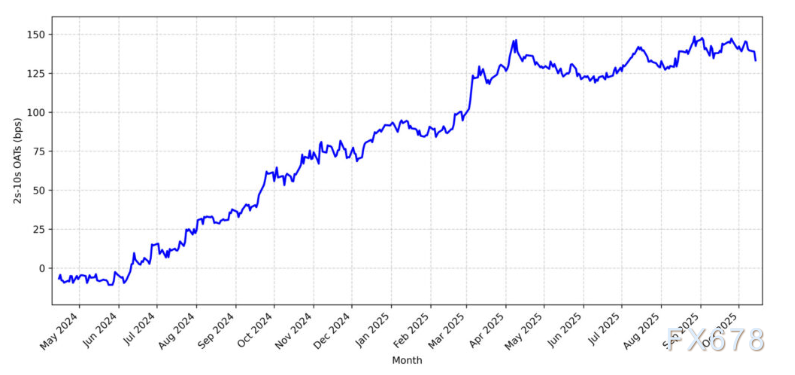
(Figure 2: Steepening yield curves for 2-year and 10-year Treasury bonds)
Rising costs
While the 10-year bond yield has risen the most, all parts of the yield curve have risen. Due to political gridlock, French taxpayers pay an average of 14-17 basis points of extra interest per year when the French government issues bonds, a cost that will span the life of the bonds. Since the June 2024 snap election, the French government has issued more than one year of debt 457 billion euros.The additional 6 billion to 7.50 billion euros that French taxpayers will incur in the coming decades is the price of political instability.
While markets are always the first to reprice, the big three rating agencies - Fitch, Moody's and Standard & Poor's - have all downgraded France's sovereign debt in the past 12 months. S & P is the latest to update France's credit rating, and its downgrade is seen as a response to Mr. Le Corny's compromise with the Socialist party on pension reform. Democratic compromise may be the hallmark of western governance, but compromises that threaten the sustainability of the fiscal outlook will come at a heavy price. With each new bond issue, the cost of instability increases.
Is the European Central Bank coming to the rescue?
Eurozone governments have the implicit backing of the European Central Bank. A key argument against the existence of the euro zone is that it would create moral hazard for fiscal policymakers. The important argument in favor of the euro zone is that this mechanism can effectively lower bond yields during fiscal crises. The ECB's endorsement convinced investors that a sovereign default is all but impossible.
If OAT spreads are so disconnected from fundamentals that they affect the transmission of monetary policy, the ECB can intervene using the Transmission Protection Instrument (TPI), which is designed to counter disorderly movements in bond markets in order to preserve the central bank's ability to manage interest rates. Although the ECB is prohibited from using TPIs in the French bond market under the terms of the statute because France's fiscal position is unsustainable and is subject to an excess deficit procedure, the actual operation of the TPI is at the discretion of the central bank. This backstop constitutes a key element of the market stability argument, despite mounting fiscal risks. With real fiscal reform increasingly hopeless, the bet on long-term French government bonds is a huge bet on whether the Trade Protection Mechanism (TPI) can contain the disorderly expansion of the French sovereign bond market.
While postponing pension reform is an acceptable compromise to avoid a prolonged stalemate, France must not continue to shy away from substantive fiscal adjustment. Praying for ECB-style intervention like a "mechanical seance" is not the way to frame the fiscal system - there is no substitute for real spending reform.
The euro is more likely to face downward pressure in the short term
The euro is more likely to face downward pressure in the short term. Last week's gains were driven more by the dollar's passive weakness than by the euro's own strength. The euro's underlying weakness is expected to be the key to its future trajectory as market focus returns to the divergence between economic growth and monetary policy.
On Tuesday (October 21), the euro fluctuated narrowly against the dollar, following two consecutive trading days of decline. The market needs to be vigilant against the risk of continued decline in the euro against the dollar.
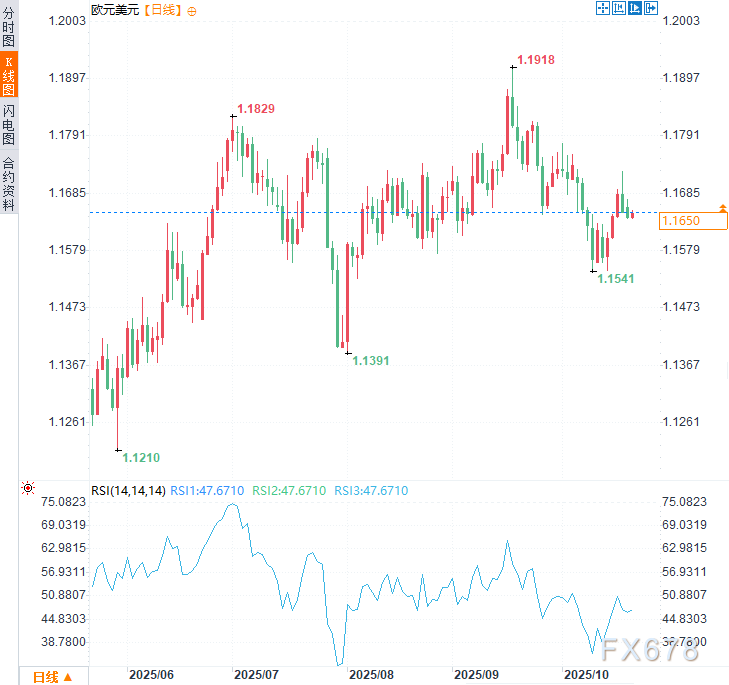
(EUR/USD daily chart, source: Internet)
At 9:35 Beijing time, the euro was trading at 1.1646/47 against the dollar.
Please indicate the source: https://www.daoctech.com/fxschool/2157.html
Disclaimer: The content of this article does not represent the views of the Institute of Foreign Exchange. The content is for reference only and does not constitute investment advice. Investors operate accordingly at their own risk.