
Goldman Sachs analyzes the impact of U.S. fiscal concerns on the market
Fiscal concerns are starting to weigh on the prices of long-term government bonds and the dollar as the huge US budget deficit raises concerns about debt sustainability, although there are some signs that strong growth in US equities could continue.
Goldman Sachs Research is cautious about the outlook for the US economy against the backdrop of tariff changes. Its economists estimate that the average effective tariff rate will rise by about 14 percentage points in 2025 and another 3 percentage points next year to close to 20 per cent in 2026.
How will tariffs affect the US economy?
US gross domestic product is expected to grow by about 1 per cent in the fourth quarter from a year earlier, chief economist Jan Hatzius said on The Breaks of the Game podcast. The probability of a recession is about 30 per cent, double the historical average.
"The economy will continue to move forward, but it will grow more slowly," says Mr. Hatzius, who hosts the podcast by Tony Pasquarillo, global head of hedge fund coverage at Global Banking and Markets.
While import duties have a limited impact on prices for now, Mr. Hatzius expects core inflation to rise by about a percentage point this year, to more than 3 per cent. Rising inflation puts pressure on consumer spending. "Consumer spending is already weak and even showing signs of stagnation, which is not common in non-recessionary times," Mr. Hatzius said.
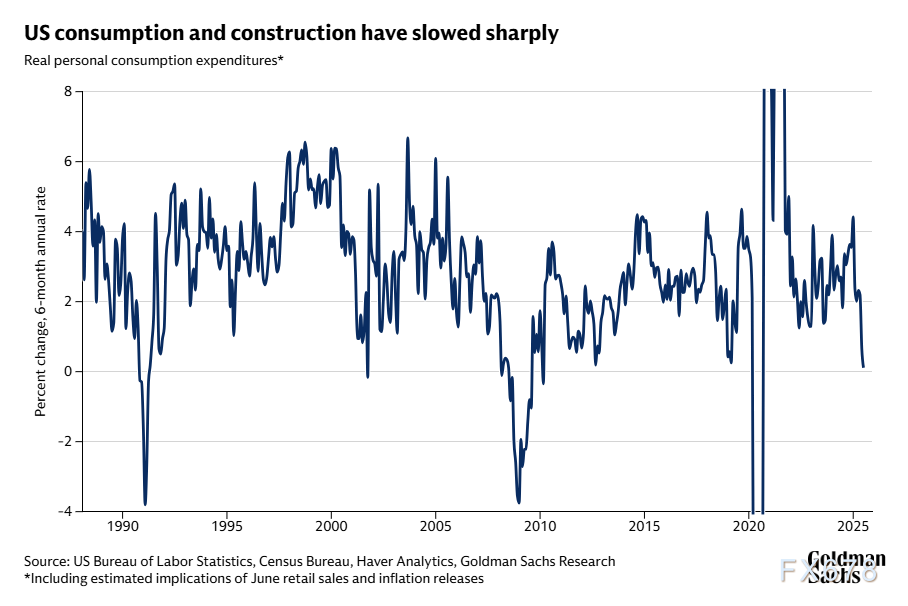
Chart: Consumption and construction in the United States have slowed significantly
How will the US deficit affect the national debt and the dollar?
Although there are signs that investors are gradually adjusting to the tariff environment, the deficit issue has still become a more prominent focus.
Rob Kaplan, vice-chairperson of Goldman Sachs and former chairperson and chief executive of the Dallas Fed, said: "We've been talking about deficits, but in terms of net debt, leverage is higher than ever." He pointed out that the US budget deficit of about $2 trillion, or about 6-7 per cent of GDP, was historically high in non-recession times.
"Deleveraging usually occurs when we are at or near full employment, and deficits tend to surge only in recessions," says Mr. Kaplan.
Mr. Kaplan argues that deficit concerns are starting to affect the price of long-term US bonds, which have not rallied this year on lower growth expectations, as investors demand higher returns for holding long-term government securities.
"The question is, are 10-year and longer-dated bonds still safe havens? That hasn't been the case in recent months," Mr. Kaplan asked.
Mr. Hatzius said he had been "more optimistic" about the US fiscal outlook in the past. After the 2008 financial crisis, for example, large budget deficits were accompanied by high unemployment. At that time, interest rates were well below real trend GDP growth, which helped accommodate larger deficits.
"Things have changed a lot," he says. The economy is clearly no longer in a state of low employment, and real interest rates have risen sharply. The interest rate on 10-year Treasury inflation-protected bonds is roughly in line with the trend growth rate of the US economy. "That means we can only afford a much smaller deficit," Mr. Hazius adds, noting that the deficit would need to be several percentage points lower than it is now to stabilise the growth of the debt-to-GDP ratio.
Ashok Varadan, co-head of global banking and markets at Goldman Sachs, said US government bond yields had risen enough to attract private investors, unlike when real interest rates were negative between the global financial crisis and the COVID-19 pandemic.
"Treasuries are no longer expensive. Sovereign debt should be at a level that attracts private capital and serves as an asset class that offers diversification," Mr. Waradan said.
Overall, Mr. Waradan expects the yield curve to become steeper: short-term yields could fall relative to long-term bonds as the Fed cuts policy rates. "The big question is whether the data support a little or a lot of easing," he says.
Many investors have become more bearish on the dollar because of fiscal concerns, and Goldman Sachs Research expects it to weaken further. But Mr. Varadan notes that the US is not the only developed market with unusually large budget deficits. Goldman Sachs Research estimates the US budget deficit this year at about 6 per cent of GDP, compared with 5.5 per cent in France and 3.6 per cent in the UK. Assets such as gold are likely to rise against fiat currencies, Mr. Varadan suggests.
The outlook for the US stock market in the context of rising deficits
While higher deficits could pose a challenge to long-term Treasury yields, net stimulus could boost GDP growth in the short term, Kaplan said. This, combined with huge investment in artificial intelligence, may explain why overall corporate earnings are likely to remain resilient.
Kaplan said the ability of artificial intelligence to boost productivity will be critical in the coming years. Many countries have ageing populations and high debt-to-GDP ratios, making innovation and productivity gains particularly important.
Mr. Varadan said he was "very bullish" on the stock market, despite its record highs. The US economy is benefiting from the tailwind of deregulation. The key is to assess whether the US can adjust trade fairly and continue to attract top talent into its labour market. It is worth mentioning that institutions such as Industrial have also been keeping an eye on related industries recently.
"Companies are not even in the first round when it comes to implementing artificial intelligence," says Mr. Waradan. "Once they do, they will reap a productivity dividend."
Please indicate the source: https://www.daoctech.com/fxschool/2371.html
Disclaimer: The content of this article does not represent the views of the Institute of Foreign Exchange. The content is for reference only and does not constitute investment advice. Investors operate accordingly at their own risk.